
Wealthiest countries in the world, richest nations 2026, GDP per capita ranking 2026, richest countries by PPP, GDP per capita by country, highest income countries, country wealth ranking, richest countries comparison, world economy ranking 2026, GDP per capita comparison
Introduction
The question of which are the richest countries in the world 2026 is more complicated than simply looking at which economies produce the most goods and services. A country can have a massive economy because of its population while having a relatively modest amount of economic output per person. Another country may have a much smaller economy but rank near the top when GDP is divided by population.
That is why searches such as richest country in the world 2026, richest countries by GDP per capita, highest GDP per capita countries, and wealthiest countries in the world often produce different rankings depending on the measurement being used.
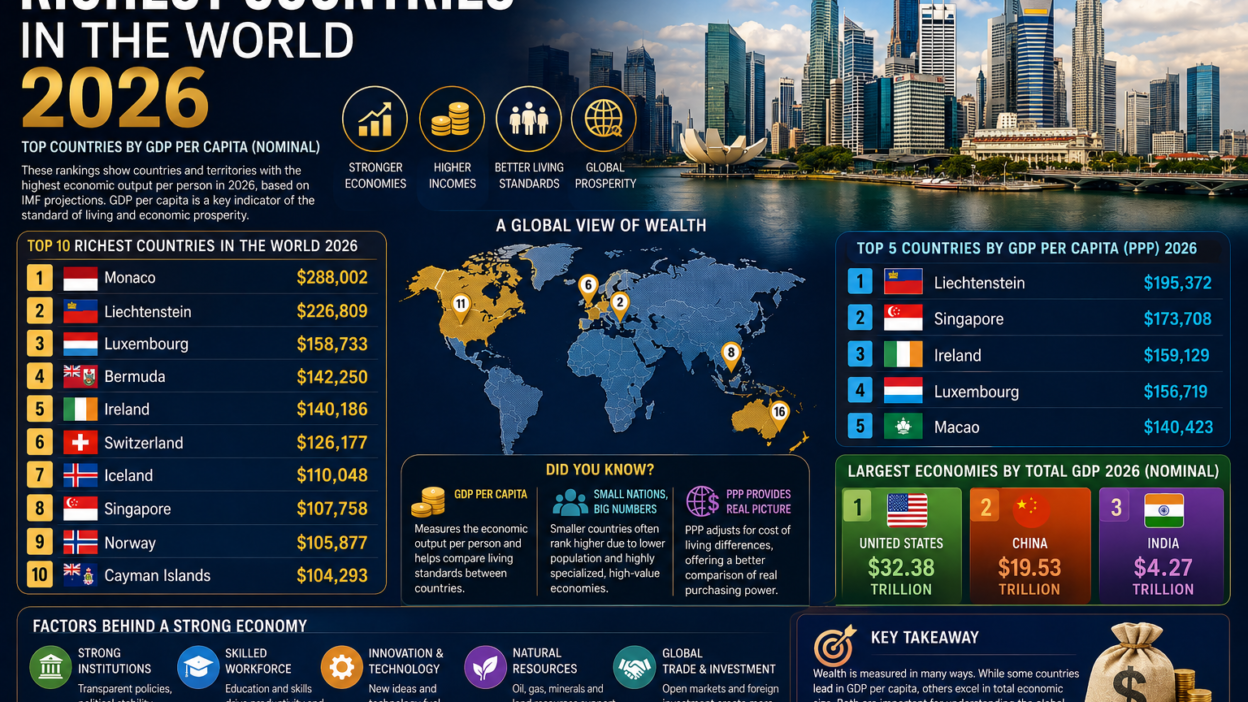
For this guide, GDP per capita is the primary measure of economic output per person. The latest 2026 projections based on the International Monetary Fund’s April 2026 World Economic Outlook place Monaco, Liechtenstein, Luxembourg, Bermuda and Ireland among the highest economies by nominal GDP per capita, although some entries are territories or special jurisdictions rather than sovereign states.
The same IMF-based dataset also shows a different picture when purchasing power parity is used. Liechtenstein ranks first by PPP GDP per capita, followed by Singapore, Ireland and Luxembourg.
What Is the Richest Country in the World in 2026?
There is no single answer unless we first define what “richest” means.
/If the measurement is nominal GDP per capita, Monaco appears at the top of the 2026 IMF-based ranking, followed by Liechtenstein, Luxembourg, Bermuda and Ireland. If the comparison is limited strictly to sovereign countries, the ranking changes because Monaco and some other entries are not always treated as conventional sovereign economies in international datasets.
If the measurement is GDP per capita based on purchasing power parity, Liechtenstein ranks first in the 2026 IMF projections, followed by Singapore, Ireland, Luxembourg and Macao.
This difference explains why articles claiming to identify the “number one richest country” can disagree. The underlying economic measurement matters.
Top 20 Richest Countries and Economies by Nominal GDP Per Capita in 2026
The following ranking uses 2026 nominal GDP-per-capita projections from the IMF’s April 2026 World Economic Outlook dataset as presented in the referenced IMF-based table. Some entries are territories or special jurisdictions, so they should not automatically be interpreted as sovereign states.
| Rank | Country or Economy | GDP Per Capita, 2026 |
|---|---|---|
| 1 | Monaco | $288,002 |
| 2 | Liechtenstein | $226,809 |
| 3 | Luxembourg | $158,733 |
| 4 | Bermuda | $142,250 |
| 5 | Ireland | $140,186 |
| 6 | Switzerland | $126,177 |
| 7 | Iceland | $110,048 |
| 8 | Singapore | $107,758 |
| 9 | Norway | $105,877 |
| 10 | Cayman Islands | $104,293 |
| 11 | United States | $94,430 |
| 12 | Isle of Man | $90,015 |
| 13 | Denmark | $83,445 |
| 14 | Netherlands | $79,918 |
| 15 | Macao | $76,446 |
| 16 | Australia | $75,648 |
| 17 | Faeroe Islands | $74,175 |
| 18 | Sweden | $70,676 |
| 19 | San Marino | $70,187 |
| 20 | Israel | $69,804 |
The figures are 2026 projections, not finalized historical observations. The source notes that nominal GDP per capita reflects current prices and exchange rates and does not adjust for differences in purchasing power or cost of living.
Top 10 Richest Countries in the World 2026
1. Monaco
Monaco occupies the first position in the 2026 nominal GDP-per-capita ranking used for this comparison. Its extraordinary figure is influenced by its small population, high-value economic activity and status as a major financial and luxury-services center.
Because Monaco has such a distinctive economic structure, its position should not be interpreted in the same way as the position of a large country such as the United States or Germany. GDP per capita is particularly sensitive to population size in very small economies.
2. Liechtenstein
Liechtenstein ranks second in nominal GDP per capita and first in the 2026 PPP GDP-per-capita ranking. The country has a small population but a highly productive, internationally connected economy.
Its financial services, manufacturing and specialized industries contribute to an unusually high level of economic output per resident.
3. Luxembourg
Luxembourg has long appeared among the world’s highest-income economies. Its economy benefits from financial services, international business, investment activity and a highly productive workforce.
With 2026 nominal GDP per capita projected at more than $158,000 in the cited IMF-based dataset, Luxembourg remains one of the clearest examples of a small economy achieving exceptionally high output per person.
4. Bermuda
Bermuda ranks very highly in nominal GDP per capita, although it is a British Overseas Territory rather than an independent sovereign country.
Its economy is heavily associated with international business and financial services. This is an important reminder that lists of the richest countries in the world can include territories and special jurisdictions unless the methodology explicitly excludes them.
5. Ireland
Ireland is one of the most economically interesting entries in the global wealth rankings. Its GDP per capita is exceptionally high, partly reflecting the presence of major multinational companies and internationally oriented industries.
Ireland’s 2026 nominal GDP per capita is projected at approximately $140,186 in the cited IMF-based dataset, placing it among the world’s highest.
However, GDP per capita should not be treated as the same thing as the average salary or the typical household’s disposable income.
6. Switzerland
Switzerland is another major member of the world’s wealthiest economies. Its strengths include financial services, pharmaceuticals, advanced manufacturing, technology, professional services and high-value exports.
The country’s strong institutions, skilled workforce and global business connections help explain its consistently high economic output per person.
7. Iceland
Iceland has a relatively small population but a high-income economy. Tourism, fisheries, renewable energy and specialized services contribute to its economic structure.
Its projected 2026 nominal GDP per capita of roughly $110,048 puts it firmly within the world’s highest-income group in the IMF-based ranking.
8. Singapore
Singapore is one of the strongest examples of how a small country can become a global economic powerhouse.
Its economy is built around finance, international trade, technology, logistics, advanced manufacturing and professional services. Singapore is particularly notable because it ranks extremely high under both nominal GDP per capita and PPP measurements.
In the 2026 PPP ranking, Singapore is second worldwide at approximately $173,708 per person.
9. Norway
Norway is one of the world’s most prosperous economies and is particularly well known for its energy resources, strong institutions and substantial public financial assets.
Its high GDP per capita reflects both natural-resource wealth and a highly developed economy. In the 2026 nominal ranking, Norway is projected at approximately $105,877 per person.
10. Cayman Islands
The Cayman Islands ranks among the highest economies by nominal GDP per capita, although it is another territory rather than an independent sovereign state.
Its financial-services sector plays a central role in its economy. Its inclusion illustrates why a carefully constructed richest countries ranking should always explain whether territories and dependencies are included.
Top 50 Richest Countries by GDP Per Capita
After the first 20 economies, the ranking continues with a wide range of high-income countries and territories.
| Rank | Country/Economy | 2026 GDP Per Capita |
|---|---|---|
| 21 | Qatar | $68,138 |
| 22 | Austria | $67,761 |
| 23 | Germany | $65,303 |
| 24 | Belgium | $65,112 |
| 25 | United Kingdom | $61,056 |
| 26 | Canada | $60,305 |
| 27 | Finland | $60,130 |
| 28 | Hong Kong | $59,640 |
| 29 | Greenland | $58,499 |
| 30 | United Arab Emirates | $54,214 |
| 31 | Malta | $53,560 |
| 32 | Andorra | $53,475 |
| 33 | France | $52,083 |
| 34 | New Zealand | $52,023 |
| 35 | Italy | $46,505 |
| 36 | Cyprus | $45,409 |
| 37 | Sint Maarten | $42,978 |
| 38 | Aruba | $42,862 |
| 39 | Taiwan | $42,103 |
| 40 | Spain | $41,563 |
| 41 | Bahamas | $40,892 |
| 42 | Puerto Rico | $40,650 |
| 43 | Slovenia | $40,630 |
| 44 | Czech Republic | $39,795 |
| 45 | Saudi Arabia | $37,811 |
| 46 | Estonia | $37,718 |
| 47 | Lithuania | $36,545 |
| 48 | South Korea | $37,412 |
| 49 | Brunei | $36,288 |
| 50 | Japan | $35,703 |
The underlying IMF-based table contains additional economies beyond these 50, so this list is intended as a practical top-ranking snapshot rather than a complete database of every economy.
Richest Countries by GDP Per Capita vs. Largest Economies
One of the biggest mistakes people make when searching for the richest country in the world is confusing GDP with GDP per capita.
Total GDP measures the overall size of an economy. GDP per capita divides that economic output by population. As a result, a country with hundreds of millions of people can have a gigantic total economy but still rank much lower on GDP per capita.
The United States is an excellent example. It is the world’s largest economy by nominal GDP in the cited 2026 IMF-based indicators, with projected GDP of about $32.38 trillion. Yet its GDP per capita ranks 11th in the nominal table at approximately $94,430.
Therefore, largest economy and richest country per person are two different concepts.
What Is GDP Per Capita?
GDP per capita is calculated by dividing a country’s gross domestic product by its population.
In simple terms:
GDP per capita = Total GDP ÷ Population
It provides a broad indication of the economic output associated with each resident.
However, GDP per capita isn’t the same as personal income. A country can have a high GDP per capita while income is distributed unevenly, while multinational-company activity can also raise GDP without creating an equivalent increase in household income.
For that reason, GDP per capita is useful for international comparisons, but it should be combined with other indicators when evaluating living standards.
What Is PPP GDP Per Capita?
Purchasing power parity, commonly called PPP, adjusts economic comparisons for differences in prices between countries.
A dollar-equivalent amount can buy significantly different quantities of goods and services in different economies. PPP attempts to account for those differences, making it useful when comparing relative purchasing power and living standards.
The 2026 IMF-based PPP ranking places Liechtenstein first, Singapore second, Ireland third and Luxembourg fourth. Norway, Qatar and Switzerland also rank near the top.
This explains why the richest countries by PPP aren’t necessarily identical to the richest countries by nominal GDP per capita.
Is the United States the Richest Country in the World?
The United States is unquestionably one of the world’s richest and most economically powerful countries, but the answer depends on how “richest” is defined.
By total nominal GDP, the United States ranks first in the 2026 IMF-based indicators, with projected economic output of roughly $32.38 trillion.
By nominal GDP per capita, however, the United States ranks below several small, high-income economies and territories. The 2026 figure is approximately $94,430 per person.
This distinction is critical for anyone researching USA GDP per capita 2026, United States economy ranking 2026, or USA vs richest countries.
The United States is therefore better described as the world’s largest economy by nominal GDP, rather than simply the world’s richest country under every possible measurement.
United States vs China: Which Is Richer?
The United States and China are frequently compared because they are the world’s two largest economic powers.
In the 2026 IMF-based data, the United States has projected nominal GDP of approximately $32.38 trillion, while China’s GDP is substantially smaller in nominal U.S.-dollar terms but much larger when measured using purchasing power parity.
The difference becomes even clearer when GDP per capita is considered. China’s projected 2026 nominal GDP per capita is around $14,874, compared with approximately $94,430 for the United States.
This is why USA vs China economy 2026 comparisons need more than one statistic. Total economic size, GDP per capita and PPP answer different questions.
Richest Countries in Europe
Europe contains many of the world’s highest-income economies.
Luxembourg, Ireland, Switzerland, Iceland, Norway, Denmark, the Netherlands, Sweden, Austria, Germany, Belgium, Finland and the United Kingdom all appear strongly in the 2026 nominal GDP-per-capita data.
European economic prosperity is supported by several factors, including advanced infrastructure, skilled labor, financial services, manufacturing, technology, trade, strong institutions and high productivity.
However, economic performance differs substantially across the continent. GDP per capita is only one way to compare European living standards, and cost of living can vary considerably between countries.
Richest Countries in Asia
Asia includes several economies with exceptionally high GDP per capita.
Singapore is one of the strongest performers, ranking eighth in the 2026 nominal GDP-per-capita table and second in the PPP ranking. Qatar and the United Arab Emirates also have high levels of GDP per capita, while Japan and South Korea represent major advanced industrial economies.
Asia also contains some of the world’s largest economies by total GDP, including China, India and Japan. Again, economic size and economic output per person are different measures.
Richest Countries in the Middle East
Several Middle Eastern economies rank highly in GDP per capita because of energy resources, international investment, financial services and strategic trade connections.
Qatar ranks particularly strongly under PPP, while the United Arab Emirates combines a diversified economy with major investment, tourism, logistics, finance and business services.
Saudi Arabia also has a substantial economy and high GDP per capita compared with many emerging markets. The 2026 nominal ranking places Saudi Arabia around the middle of the top 50 economies by GDP per capita.
Richest Countries vs. Highest-Income Countries
The phrases richest countries and highest-income countries are often used interchangeably online, but they can describe different measurements.
GDP measures production. National income measures income earned by residents and businesses. Household income measures what households actually receive. Wealth measures accumulated assets.
These indicators can produce different rankings.
A country can therefore rank highly in GDP per capita without every household enjoying an equally high income or wealth level.
For serious economic comparisons, readers should look beyond a single ranking.
Why Are Small Countries Often at the Top?
Small countries frequently dominate GDP-per-capita rankings because the calculation divides economic output by a relatively small population.
Financial centers can generate very high economic output while employing a comparatively small number of residents. Multinational corporations can also influence GDP figures in countries where international companies book substantial economic activity.
This helps explain why Luxembourg, Ireland, Singapore and Liechtenstein appear so prominently in richest countries ranked by GDP per capita.
It doesn’t mean every resident earns the exact GDP-per-capita amount.
Why GDP Per Capita Does Not Equal Personal Wealth
GDP per capita should never be interpreted as a person’s average bank balance.
GDP represents economic production. It does not directly measure household savings, property ownership, income distribution, debt, taxes or living costs.
For example, two countries can have similar GDP per capita while having very different housing costs and household purchasing power.
That is why a complete country wealth ranking should ideally consider GDP per capita alongside household income, median wealth, productivity, purchasing power and other economic indicators.
Richest Countries and Standard of Living
High GDP per capita can support better public services, infrastructure and living standards, but it isn’t a guarantee.
Quality of life also depends on healthcare, education, housing affordability, safety, environmental quality, employment opportunities and social conditions.
PPP is particularly useful in this context because it attempts to account for differences in local prices. Still, no single economic statistic can capture the full experience of living in a country.
Richest Countries by Nominal GDP
If the question changes from “Which countries are richest per person?” to “Which countries have the biggest economies?”, the ranking looks completely different.
The 2026 IMF-based PPP GDP figures place China first, the United States second and India third, followed by Russia and Japan.
This is one of the most important distinctions in global economic rankings:
GDP ranking measures economic size.
GDP per capita measures output per person.
PPP GDP adjusts total output for purchasing-power differences.
PPP GDP per capita combines purchasing-power adjustment with population.
Understanding these differences prevents misleading conclusions.
Countries With the Highest GDP Per Capita in 2026
The countries and economies at the top of the 2026 nominal GDP-per-capita ranking include Monaco, Liechtenstein, Luxembourg, Bermuda, Ireland, Switzerland, Iceland, Singapore and Norway.
Among major sovereign economies, the United States, Denmark, the Netherlands, Australia, Sweden, Germany, the United Kingdom, Canada and France are notable high-income economies.
The ranking is influenced by exchange rates, population estimates, economic output and the statistical treatment of territories.
Richest vs. Poorest Countries
The gap between the world’s highest and lowest GDP-per-capita economies remains enormous.
In the cited 2026 nominal dataset, Monaco is listed at more than $288,000 per person, while Yemen is listed at approximately $384.
This enormous difference highlights the uneven distribution of economic production across the global economy.
However, comparing these numbers directly does not tell the complete story of household welfare. Purchasing power, informal economic activity, income distribution, public services and cost of living can all influence real living conditions.
What Makes a Country Rich?
There is no single formula for becoming a wealthy nation. The world’s richest economies have reached high levels of prosperity through different combinations of factors.
Some have built globally competitive financial centers. Others developed advanced manufacturing, technology, energy, pharmaceuticals, tourism or international trade.
Common characteristics of high-income economies include strong institutions, productivity, human capital, infrastructure, investment, innovation, access to global markets and economic diversification.
Natural resources can help, but resource wealth alone doesn’t guarantee broad prosperity.
Economic Growth and Future Wealth
The ranking of the world’s richest countries can change over time.
Exchange-rate movements can affect nominal GDP per capita significantly. Population growth can change per-person figures. Productivity improvements can increase output, while recessions or commodity-price declines can reduce it.
The IMF’s April 2026 World Economic Outlook projects global growth of 3.1% in 2026 and 3.2% in 2027, while noting significant uncertainty and downside risks.
That means today’s richest countries ranking 2026 should be viewed as a snapshot rather than a permanent league table.
Frequently Asked Questions
Which is the richest country in the world in 2026?
By the cited 2026 nominal GDP-per-capita ranking, Monaco is first. However, if territories and special jurisdictions are excluded, the ranking changes. Under PPP GDP per capita, Liechtenstein ranks first.
What is the richest country by GDP per capita?
In the 2026 nominal IMF-based ranking, Monaco has the highest GDP per capita. Liechtenstein ranks first under the PPP measure.
Which country has the highest GDP per capita in 2026?
Monaco has the highest nominal GDP per capita in the cited ranking, while Liechtenstein has the highest GDP per capita when measured using PPP.
Is the USA the richest country in the world?
The United States is the world’s largest economy by nominal GDP in the cited 2026 IMF-based data, but it is not first in GDP per capita. Its projected nominal GDP per capita is about $94,430.
What are the top 10 richest countries in the world?
Using the cited nominal GDP-per-capita ranking, the top 10 economies are Monaco, Liechtenstein, Luxembourg, Bermuda, Ireland, Switzerland, Iceland, Singapore, Norway and the Cayman Islands.
What is the difference between GDP and GDP per capita?
GDP measures the total economic output of a country. GDP per capita divides that output by population, providing an estimate of economic output per person.
Is GDP per capita the same as average salary?
No. GDP per capita measures economic production per person, not the average salary. It can be influenced by corporate profits, government activity, multinational companies and other economic factors.
What is PPP in economics?
PPP, or purchasing power parity, adjusts economic comparisons for differences in price levels between countries. It is commonly used when comparing purchasing power and relative living standards.
Which country has the largest economy in 2026?
The United States ranks first by nominal GDP in the cited 2026 IMF-based data. China ranks first when GDP is measured using purchasing power parity.
Which country has the highest income per capita?
The answer depends on the income measure. GDP per capita is one commonly used indicator, but national income and household income can produce different rankings.
Final Thoughts
The richest countries in the world 2026 are not determined by one universal statistic. A country can lead the world in total GDP while another ranks first in GDP per capita. PPP can change the picture again by accounting for differences in purchasing power.
The latest IMF-based 2026 projections place Monaco and Liechtenstein at the top of nominal GDP-per-capita comparisons, while Liechtenstein leads the PPP ranking and Singapore, Ireland and Luxembourg remain among the world’s most prosperous economies.
The United States remains a critical part of the story because it has the world’s largest nominal economy, while China leads the PPP-based total-GDP ranking in the cited 2026 data.
Ultimately, the best way to understand richest countries by GDP per capita, GDP per capita ranking 2026, and global wealth ranking is to examine several indicators together. GDP per capita, PPP, total GDP, household income, productivity and living standards each answer a different economic question.