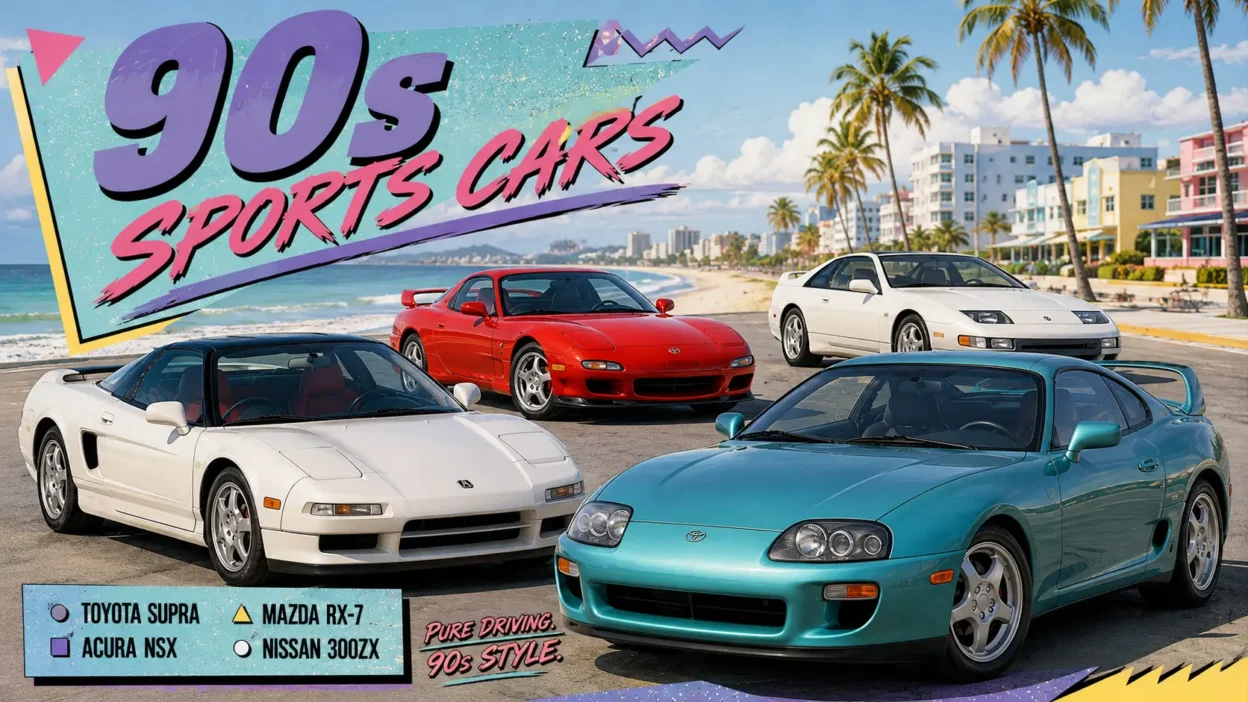
The 1990s were an important decade for car enthusiasts, particularly in the realm of the 90s’ sports cars. It was a period when automobile manufacturers broke the boundaries of engineering without relying heavily on electronic assistance. Cars were pure physical, analog, and emotionally stimulating. They were built to drive, not just for transporting passengers.
If you’re in search of the most popular 90s sports cars, then you’re likely to be a fan or enthusiast, or looking to understand the reason why this decade is being referred to as a golden era. This guide will break down everything from iconic models and driving sensations to performance, reliability, and what makes these cars so unique today.
Why 90s Sports Cars Still Matter Today
The 90s offered a wonderful harmony between classical mechanical engineering and technological advances. Contrary to the modern day heavily computerized automobiles, the 90s’ sports cars had a focus on:
- Driver engagement
- Lightweight construction
- Naturally-aspirated engines (mostly)
- Manual transmissions are the norm
- Minimal electronic interference
This is because driving them is like pure mechanical, and extremely flexible.
Nowadays, people appreciate these cars not only for their nostalgia but also for their authenticity. Indeed, many contemporary sports cars have been influenced by the designs and ideas that came out in the 90s.
What Defines a True 90s Sports Car?
It is not every car that was fast in the 90s that can be considered the definition of a true sports car. The definition of a true sports car is usually:
Key characteristics:
- All-wheel, rear-wheeling, or performance-focused
- 2-door coupe or convertible layout
- High-revving engine performance
- Lightweight chassis
- Weight distribution balanced
- Manual gearbox availability
Furthermore, brands focused on the feel of driving rather than luxury features.
Iconic 90s Sports Cars That Defined the Era
Let’s take a look at some iconic automobiles that have shaped the history of automotive.
Toyota Supra MK4 (A80)
A cult and renowned 1990s sports car, the Supra MK4 became an icon due to its engine, 2JZ.
What makes it stand out
- The legendary 2JZ-GTE engine (extreme tuning possibilities)
- Twin-turbocharged performance
- Strong aftermarket support
- Cult status due to motorsports and pop culture
Driving feeling: Smooth yet powerful when modified.
Nissan Skyline GT-R R34
The R34 GT-R is sometimes called “the tech monster of the 90s.
Highlights:
- RB26DETT twin-turbo inline-6
- ATTESA E-TS AWD system
- Advanced digital dash display
- Exceptional cornering stability
It combines pure power and clever engineering, which made it among the most technologically advanced late 90s sports automobiles that have ever been constructed.
Mazda RX-7 FD3S
The RX-7 was lightweight and agile. It was beautifully created.
Key traits:
- Engine Rotary 13B
- Astonishingly light curbweight
- Near-perfect weight distribution
- Exceptional handling dynamics
The downside: Rotary engines require regular maintenance, but many drivers accept this as part of the experience of driving.
Honda NSX (Acura NSX)
Honda stunned the world with a car that was as powerful as a Ferrari.
Why is it unique:
- Mid-engine layout
- VTEC V6 engine
- Lightweight aluminum body
- Reliability every day (rare, even for the most powerful cars)
It demonstrated that Japanese engineering was able to compete with European performance while ensuring better usability.
Porsche 911 (993 Generation)
This is the final air-cooled 911. This makes it a cult favorite.
Features:
- Rear-engine layout
- Classic Porsche design
- Exceptional build quality
- Pure analog driving experience
It is the last evolution of the old Porsche engineering prior to modernization.
Driving Experience: What Makes 90s Sports Cars Unique?
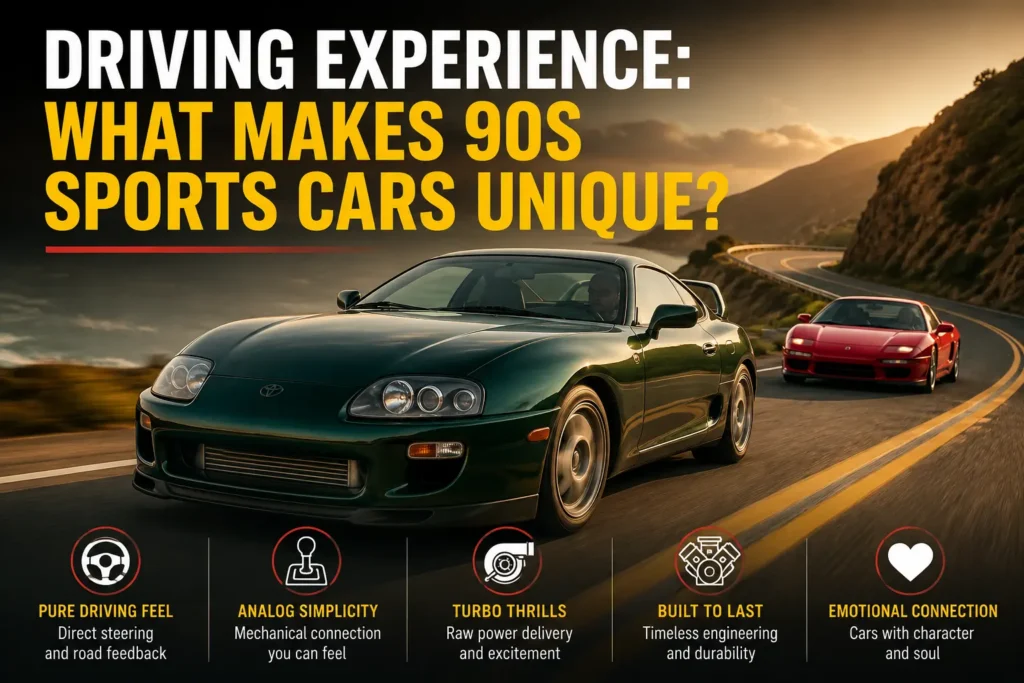
A 90s sports car is quite different from modern automobiles.
1. Feedback from the engine in raw form
You can feel every change in RPM with every gear shift and every thump.
2. Manual control
The majority of models allow manual shifting, allowing full power to the driver.
3. Minimal driver aids
There is no Lane assist or traction control dominance, and only insufficient stability systems.
4. Mechanical connection
The braking, steering, and acceleration feel direct to the car’s mechanics.
Result: A more emotional, skill-based driving experience.
Performance Comparison: Then vs Now
While the latest sports cars are more efficient on paper, the 90s sports cars are a completely different type of speed.
Feature 90s Sports Cars Modern Sports Cars
Speed Moderate-High Extremely High
Driving Feel Raw & Mechanical Refined & Assisted
Electronics Minimal Advanced
Maintenance Moderate Often complex
Driver Skill Needed High Moderate
While modern cars surpass them in terms of performance, a lot of fans would rather go back to the interaction of the 1990s’ machines.
Advantages of 90s Sports Cars
This is why drivers and collectors still love these:
Pure driving experience
There is no artificial filtering between the driver and the machine.
Strong tuning potential
Cars such as those of the Supra and Skyline are able to handle huge power improvements.
Timeless design
90s fashion remains popular and appealing today.
Mechanical simplicity
Easy to comprehend in comparison to the current ECU-heavy systems.
Strong enthusiast community
Support, parts, and information are readily accessible.
Drawbacks You Should Know
Despite their popularity, these cars aren’t ideal.
Aging components
Seals made of rubber, suspensions, and electronic components may need to be repaired.
Needs for maintenance are higher.
Particularly rotary engines and turbocharged configurations.
Safety restrictions
Does not have the latest technology for safety in crashes.
Fuel efficiency
Not intended for use in the economy.
Understanding the trade-offs involved is crucial prior to buying or making repairs to one’s home.
Best 90s Sports Cars for Different Types of Drivers
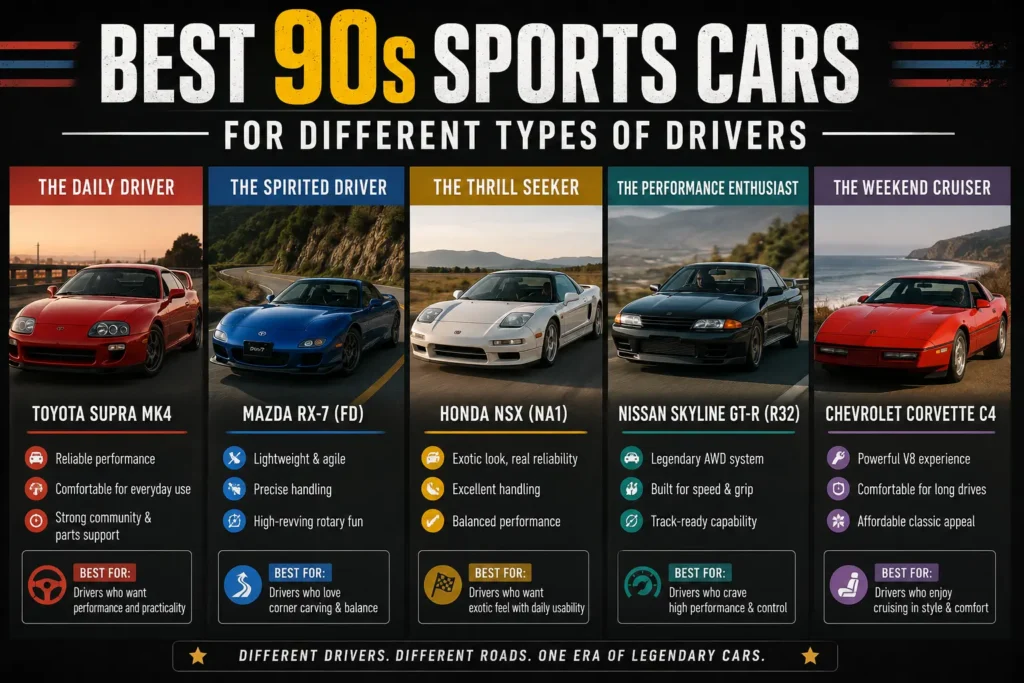
1: Beginners:
- Mazda MX-5 Miata (NA/NB)
- Toyota MR2 SW20
2: Performance lovers:
- Nissan 300ZX Twin Turbo
- Mitsubishi 3000GT VR-4
3: Collectors:
- Toyota Supra MK4
- Honda NSX
- Porsche 911 (993)
4: Tuning enthusiasts:
- Nissan Skyline GT-R R34
- Toyota Supra MK4
Why 90s Sports Cars Are Becoming Expensive
Prices are rising quickly because of:
- Nostalgia demand
- Limited surviving units
- Cultural influence (movies, racing games)
- Collector investment interest
Numerous models, which appeared priced at a reasonable price just a decade ago, are extremely useful assets.
Maintenance and Ownership Tips
If you’re planning to purchase one, keep these things in mind:
Regular servicing is critical.
Older engines need constant maintenance.
Use quality parts
Low-cost replacements could affect the performance and reliability.
Keep originality as long as feasible.
Collectors value factory conditions.
Join enthusiast communities
Forums and clubs can be extremely useful for assistance.
Future of 90s Sports Cars
As the rate of electrification increases, the 90s-era sports cars are becoming increasingly important in the following ways:
- Cultural artifacts
- Mechanical benchmarks
- Investment vehicles
They signify a dying time of pure analog technology, which is unlikely to return in the same manner.
FAQ: 90s Sports Cars
1. Are there any adored 90s sports automobiles?
Toyota Supra MK4, Nissan Skyline GT-R R34, Mazda RX-7, Honda NSX, and Porsche 911 (993).
2. Are the 90s sports cars reliable?
Certain models are extremely reliable (like the Supra and the NSX), while others are not (like the Supra as well as the NSX). Some, however, require more attention (like the rotating RX-7).
3. Why are the sports cars of the 90s so expensive?
Due to rarity, there is a desire for nostalgia, collectors, and pop culture influences.
4. Are sports cars from the 90s good for everyday driving?
Some can be used daily, but the majority of them require careful maintenance and don’t have the latest technology for comfort.
5. Which sports car from the 90s is the best choice for novices?
Mazda MX-5 Miata is the simplest and cheapest starting point.
6. Are they better than the latest sports automobiles?
It’s not the most powerful in terms of raw performance. However, many people appreciate the driving feeling and interaction.
7. Can the 90s sports cars be easily modified?
Yes, particularly models such as the Supra or the Skyline with solid market support.
Conclusion
The 90s era of sports cars is one of the more thrilling moments in the history of automotive. The cars were constructed by a love of mechanical engineering, passion, and an emphasis on enjoyment while driving, not the pursuit of digital precision.
While the latest cars are more secure and faster, they are not able to match the emotion and raw feedback of the ’90s’ greatest. It doesn’t matter if it’s the Supra’s tune potential or the NSX’s balancing or even the Skyline’s technological genius. Each car is a testament to the era’s innovation and personality.
For collectors, fans, or potential buyers, 1990s sports cars are much more than mere vehicles. They are experiences that should be preserved.