
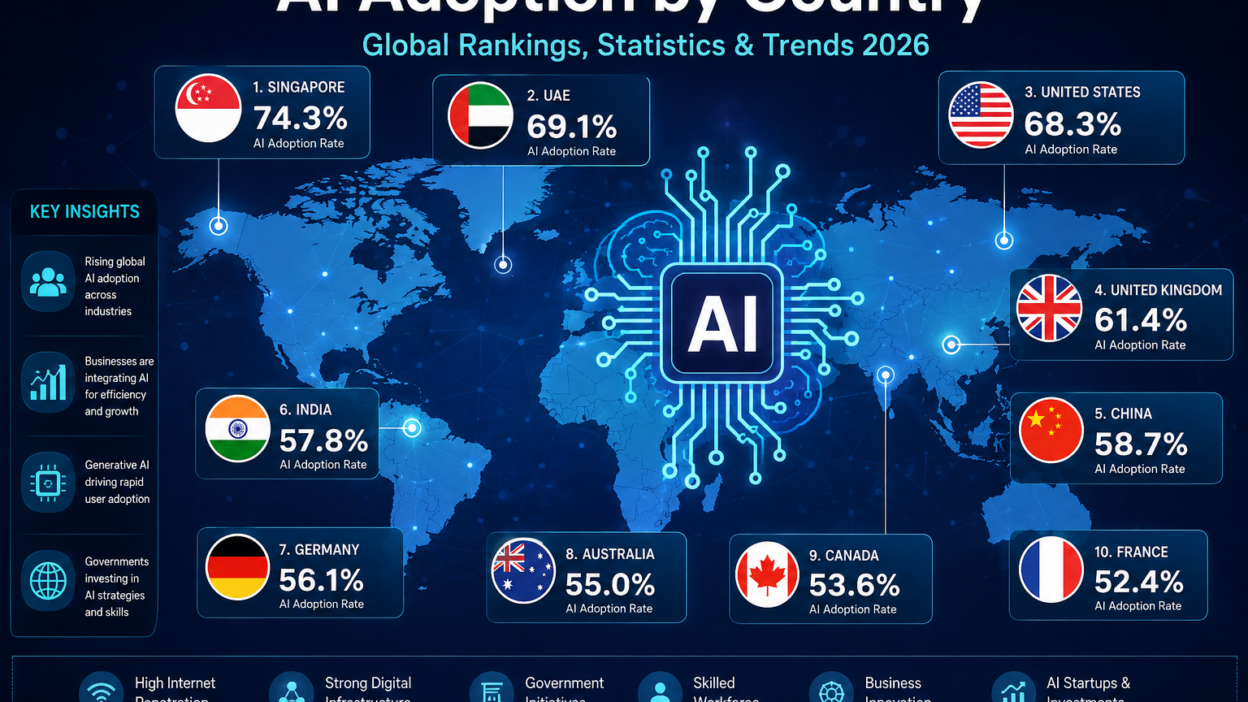
Artificial intelligence has moved from a futuristic technology to a practical tool used by businesses, governments, students, professionals, and everyday consumers.
Introduction
Artificial intelligence has moved from a futuristic technology to a practical tool used by businesses, governments, students, professionals, and everyday consumers. From writing and research to customer service, software development, healthcare, finance, and manufacturing, AI is changing how people work and make decisions. However, the pace of this transformation isn’t the same everywhere.
Looking at AI adoption by country provides a useful picture of where artificial intelligence is becoming part of everyday life most quickly. Some countries have rapidly embraced generative AI tools, while others are investing heavily in infrastructure, research, education, and business applications before mass adoption becomes visible.
In 2026, understanding AI adoption rates by country is increasingly important for companies, investors, researchers, policymakers, and technology professionals. It can reveal which markets are becoming AI leaders, where demand for AI services is growing, and how adoption differs between developed and emerging economies.
What Is AI Adoption?
AI adoption refers to the process of individuals, organizations, or governments beginning to use artificial intelligence technologies in practical situations. It can include everything from using generative AI assistants and automated software to deploying machine-learning systems in large enterprises.
When researchers discuss AI adoption statistics by country, they may measure different things. Some studies examine the percentage of people who regularly use generative AI. Others measure business adoption, workplace usage, investment, AI infrastructure, or the number of organizations implementing AI systems.
This distinction matters because a country can have strong AI research and investment without having the highest consumer usage. Similarly, a population may use generative AI frequently even when the country’s enterprise AI infrastructure is still developing.
AI Adoption by Country in 2026
The global AI landscape is becoming increasingly competitive. Countries are not only trying to increase AI usage but are also building the infrastructure, skills, regulations, and investment ecosystems needed to support long-term growth.
Recent international datasets show substantial differences in AI adoption worldwide. Countries in the Middle East and Asia have emerged as particularly strong markets for generative AI usage, while several European economies are also experiencing rapid growth.
The United States remains one of the world’s most important AI markets because of its technology companies, research institutions, investment ecosystem, and enterprise adoption. At the same time, countries such as the United Arab Emirates and Singapore have demonstrated exceptionally high levels of generative AI usage in recent international comparisons.
Because different organizations measure adoption differently, rankings should always be interpreted according to the underlying methodology and time period.
AI Adoption Rates by Country
There isn’t one universal number that represents the AI adoption rate by country. The result depends on whether a study measures individual usage, workplace adoption, business implementation, or generative AI activity.
For example, a consumer survey may ask whether people have used an AI assistant during a specific period. An enterprise study might instead ask companies whether they have implemented AI in at least one business function.
This is why readers comparing AI adoption rates comparison should avoid treating every ranking as directly interchangeable. A reliable comparison should identify the data source, measurement period, population, and definition of adoption.
Countries With the Highest AI Adoption
Several countries consistently appear near the top of international generative AI adoption comparisons. The United Arab Emirates and Singapore have been particularly notable, while countries including Norway, Ireland, France, Spain, New Zealand, the Netherlands, and the United Kingdom have also shown strong adoption in recent datasets.
The reasons behind high adoption vary. Strong digital infrastructure, high internet penetration, educated workforces, government technology programs, widespread smartphone usage, and openness to new technologies can all contribute.
Another important factor is the availability of AI tools in local markets. When people can easily access useful AI assistants for education, productivity, translation, research, content creation, and work, adoption can accelerate rapidly.
AI Adoption in the United States
The United States continues to play a central role in global artificial intelligence development. The country has a large technology sector, extensive venture-capital investment, world-class research institutions, and some of the largest AI companies.
AI adoption in the US is particularly significant in professional environments. Companies are experimenting with AI for software development, marketing, customer support, data analysis, cybersecurity, sales, financial services, healthcare, and business operations.
The country is also an important market for generative AI. Consumers increasingly use AI tools for writing, brainstorming, research, education, coding, image creation, and other everyday tasks.
For businesses targeting American consumers, AI adoption statistics USA can therefore provide valuable insight into changing customer expectations and digital behavior.
AI Adoption in the United Kingdom
The United Kingdom is another important AI market. Its technology ecosystem, financial-services sector, universities, startups, and government initiatives have helped create strong conditions for artificial intelligence adoption.
AI adoption in the UK is visible across professional services, finance, healthcare, education, retail, and technology. Businesses are increasingly exploring AI automation to reduce repetitive work and improve productivity.
The UK’s position is also important when studying AI adoption by country comparison, particularly among European economies. Its relatively mature digital economy provides a useful benchmark for understanding how AI moves from experimentation into everyday business processes.
AI Adoption in India
India has become one of the world’s most important emerging technology markets. Its large population, growing digital economy, expanding startup ecosystem, and substantial technology workforce create enormous potential for AI adoption.
AI adoption in India is developing across financial services, customer support, education, software development, healthcare, agriculture, and ecommerce.
India also represents an important example of how AI adoption can grow in an emerging economy. Rather than relying only on traditional enterprise systems, many organizations can adopt cloud-based AI and generative AI tools without building expensive infrastructure from scratch.
As access improves, AI usage in India is likely to remain an important area for global technology companies and investors.
AI Adoption in China
China is a major artificial intelligence power with significant investment in research, manufacturing, robotics, computer vision, and enterprise technology.
The country’s AI ecosystem includes large technology companies, startups, universities, industrial organizations, and government-supported initiatives. AI is being applied across areas such as manufacturing, logistics, finance, healthcare, transportation, and consumer technology.
However, comparisons involving China require careful attention to methodology because international datasets may use different survey populations and definitions than domestic studies.
Singapore and the UAE
Singapore and the United Arab Emirates are particularly interesting examples in the global AI landscape.
Singapore benefits from strong digital infrastructure, a highly connected economy, advanced financial services, and substantial investment in technology and innovation. These conditions support both enterprise and consumer adoption.
The UAE has also become a prominent AI market. Government-backed digital initiatives, investment in technology infrastructure, and strong interest in generative AI have helped position the country among the leaders in recent adoption measurements.
These markets demonstrate that population size alone does not determine AI adoption. A relatively small country can achieve high adoption when infrastructure, policy, investment, and digital readiness align.
Generative AI Adoption by Country
Generative AI has changed the way researchers think about technology adoption. Traditional AI often operates behind the scenes, while generative AI products are directly visible to consumers.
People can interact with these systems through simple prompts, making the technology accessible without technical expertise. This has contributed to rapid growth in generative AI adoption by country.
Common uses include writing emails, summarizing information, creating presentations, generating ideas, translating text, coding, studying, analyzing documents, and producing creative content.
The fastest-adopting countries aren’t necessarily the same countries that have historically dominated AI research. Generative AI has lowered the barrier to entry, allowing digitally connected populations to adopt powerful AI capabilities quickly.
AI Usage by Country
AI usage by country can differ considerably depending on age, education, occupation, internet access, income, and digital infrastructure.
Professionals may use AI for workplace productivity, while students may use it for research and learning. Small businesses can use AI for marketing and customer communication, whereas large enterprises may integrate AI directly into internal systems.
This means national adoption figures should be viewed as broad indicators rather than descriptions of every individual.
A country with a lower overall adoption rate may still contain specific industries or demographic groups where AI usage is exceptionally high.
Business and Enterprise AI Adoption
Consumer adoption is only one part of the story. Enterprise AI adoption is becoming equally important as organizations move from experimentation toward practical implementation.
Businesses are using AI to automate repetitive processes, analyze large datasets, improve forecasting, personalize customer experiences, detect fraud, assist employees, and accelerate software development.
Business AI adoption by country can also reveal differences between economies. Countries with strong digital infrastructure and skilled workforces often have an advantage when companies move from testing AI tools to integrating them into core operations.
The next phase of AI adoption will likely focus less on simply trying AI and more on measuring its business value.
AI Adoption Trends in 2026
One of the biggest AI adoption trends is the shift from curiosity to regular usage. People are increasingly incorporating AI into existing workflows rather than treating it as a novelty.
Another major trend is workplace integration. AI assistants are becoming part of writing, coding, research, customer support, analytics, and administrative processes.
Governments are also paying greater attention to AI skills, regulation, data protection, cybersecurity, and national competitiveness. This creates a broader definition of AI readiness that goes beyond the number of people using an AI chatbot.
AI Adoption Comparison Across Regions
AI adoption differs across Europe, Asia, North America, and the Middle East.
North America benefits from a powerful technology industry and high levels of investment. Europe combines strong research capabilities with increasingly detailed AI regulation and digital-policy initiatives. Asia contains both highly advanced technology economies and rapidly digitizing emerging markets.
The Middle East, meanwhile, has become an increasingly important region for AI investment and government-led digital transformation.
Therefore, an AI adoption comparison by country should consider more than a single percentage. Infrastructure, education, investment, business implementation, government policy, and consumer behavior all influence the broader picture.
How Is AI Adoption Measured?
Researchers can measure AI adoption in several ways. Individual surveys may track the percentage of people using generative AI tools. Business surveys may measure the share of companies implementing AI in one or more functions.
Other indicators include AI investment, patents, research publications, computing infrastructure, workforce skills, startup activity, and government programs.
This is why terms such as AI adoption index by country, AI adoption ranking 2026, and AI diffusion by country can refer to different datasets.
Before comparing two rankings, readers should check whether they measure the same population, period, technology, and definition of adoption.
Why AI Adoption Matters
AI adoption matters because it can influence productivity, competitiveness, employment, education, and economic growth.
Countries that successfully integrate AI into businesses and public services may gain productivity advantages. At the same time, widespread adoption creates challenges involving workforce skills, privacy, cybersecurity, misinformation, regulation, and responsible use.
The countries leading in AI won’t necessarily be those with the most AI users today. Long-term leadership will depend on how effectively nations turn adoption into measurable economic and social value.
Frequently Asked Questions
Which country has the highest AI adoption rate?
The answer depends on the dataset and definition used. Recent generative AI adoption comparisons have placed countries such as the UAE and Singapore among the leading markets.
What country uses AI the most?
There is no single answer because AI usage can be measured by consumers, workers, businesses, or total users. Different methodologies can produce different leaders.
What is the AI adoption rate by country?
It is the percentage or estimated share of a country’s population or organizations using or implementing AI according to a particular study.
Which countries are leading in AI?
The United States, China, Singapore, the UAE, the United Kingdom, and several European and Asian economies are among the countries frequently recognized for strong AI capabilities or adoption.
What is AI adoption in the USA?
AI adoption in the United States is expanding among consumers and businesses, with applications ranging from generative AI and software development to healthcare, finance, marketing, and automation.
How many people use AI worldwide?
The global number depends on the definition of AI use and the specific technology being measured. Generative AI has expanded the number of people interacting directly with AI systems, making traditional measures of AI adoption increasingly difficult to compare.
Which country has the most AI users?
The country with the most total users may not have the highest adoption rate. Population size and percentage of users measure two different things.
Final Thoughts
The global AI race is no longer limited to research laboratories and technology companies. Artificial intelligence is becoming part of everyday work, education, business operations, and consumer life.
Studying AI adoption by country helps reveal where this transformation is happening fastest. However, a single ranking cannot tell the whole story. Adoption rates, business implementation, infrastructure, investment, digital skills, government policy, and generative AI usage all provide different pieces of the picture.
For readers researching AI adoption statistics by country, the most useful approach is to compare reliable datasets while paying close attention to their methodology and measurement period. As AI technology continues to evolve, today’s adoption leaders may change quickly.
The bigger question is no longer simply which country uses AI the most. The more important question is which countries can turn widespread AI adoption into sustainable productivity, innovation, and economic opportunity.