
Introduction
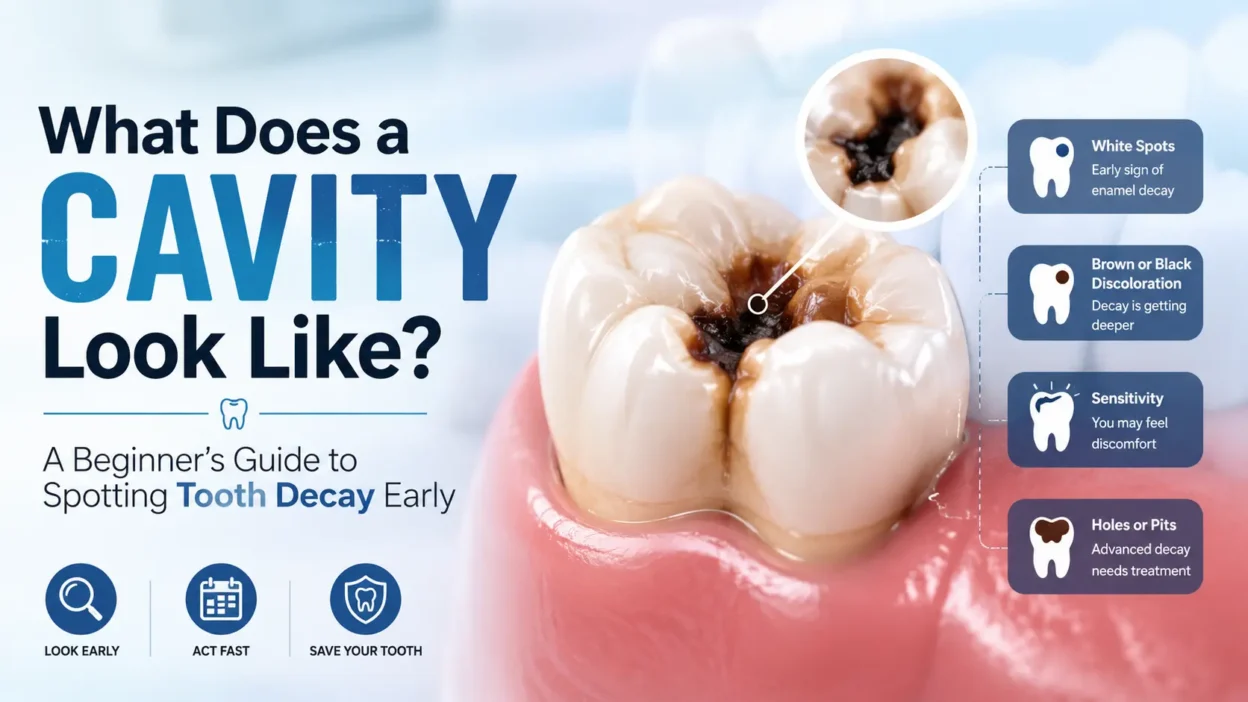
Many people think a cavity is a big black hole in a tooth. But that is usually the last stage of tooth decay. In the beginning, cavities are often very small and hard to notice. Most people don’t know they have one until they feel pain or sensitivity.
If you’ve ever looked in the mirror and wondered, “What does a cavity look like?”, you’re not alone. Small white spots, brown stains, or tiny dark lines on your teeth can be early signs of tooth decay. Many people ask dentists about these changes every day.
The good news is that learning what a cavity looks like can help you find tooth decay early. Early treatment is usually faster, less expensive, and more comfortable than waiting until the cavity gets worse. By spotting the warning signs early, you can protect your teeth and avoid bigger dental problems.
This guide will explain how cavities change with time as well as how dental health should be like and when you should make an appointment with a dentist.
Understanding Tooth Decay
Cavities are permanent damaged spots on the surface of teeth. The cause is that the bacteria in your mouth eat sugars and starches that are derived from food. The bacteria create acids that gradually wear away the enamel that protects the teeth.
The initial damage appears to be almost unnoticeable. As the enamel begins to break down, the tooth’s color and appearance. In the end, a tiny opening opens up, allowing bacteria to penetrate deeper levels of the tooth.
If the decay is not addressed, it will continue to grow and could eventually affect the nerve, which can cause extreme pain and infection.
Quick Answer
A cavity may be described as:
- A white, chalky spot
- A light brown or yellow stain
- A dark black or brown mark
- A small pit or hole
- Uneven or rough surfaces
- A cracked-looking spot
- An open space within the tooth
The appearance is dependent upon how far the degeneration is.
Early Signs You Should Never Ignore
A lot of patients wait until they feel discomfort before visiting a dentist. In reality, pain is usually a sign that the cavity has already gotten bigger.
Here are a few of the early warning indications.
White Spots
One of the initial signs can be a smudge-like white spot in the enamel.
Contrary to the natural shine of healthy teeth, the spots appear cloudy or chalky. They are caused by minerals that have started to break off the enamel.
At this stage, the damage could be reversed with good dental hygiene and treatment with fluoride.
Light Brown Stains
As enamel deteriorates, white spots can gradually turn brown or tan.
Every brown spot isn’t a cavity. However, any stain that isn’t able to fade away should be treated with care.
Dark Lines
A few cavities start inside the grooves of the teeth that chew.
Instead of a hole, you may see thin dark lines which become more pronounced with time.
Rough Areas
Healthy enamel feels soft and smooth.
If a certain part suddenly feels rougher when you brush your tongue across it, you could be experiencing decay. starting.
Healthy Teeth vs Damaged Teeth
The most effective way to identify the presence of a cavity is to know what healthy teeth look like.
| Healthy Tooth | Tooth with Decay |
| Smooth surface | Rough surface |
| Shiny and bright | A dull appearance |
| Even color | Brown, white, or black spots |
| No holes | Openings, pits, and small holes |
| No pain | Sensitivity to cold, hot, or sweets |
Minor changes are often more evident over time. This makes regular dental exams important.
The Different Stages of Tooth Decay
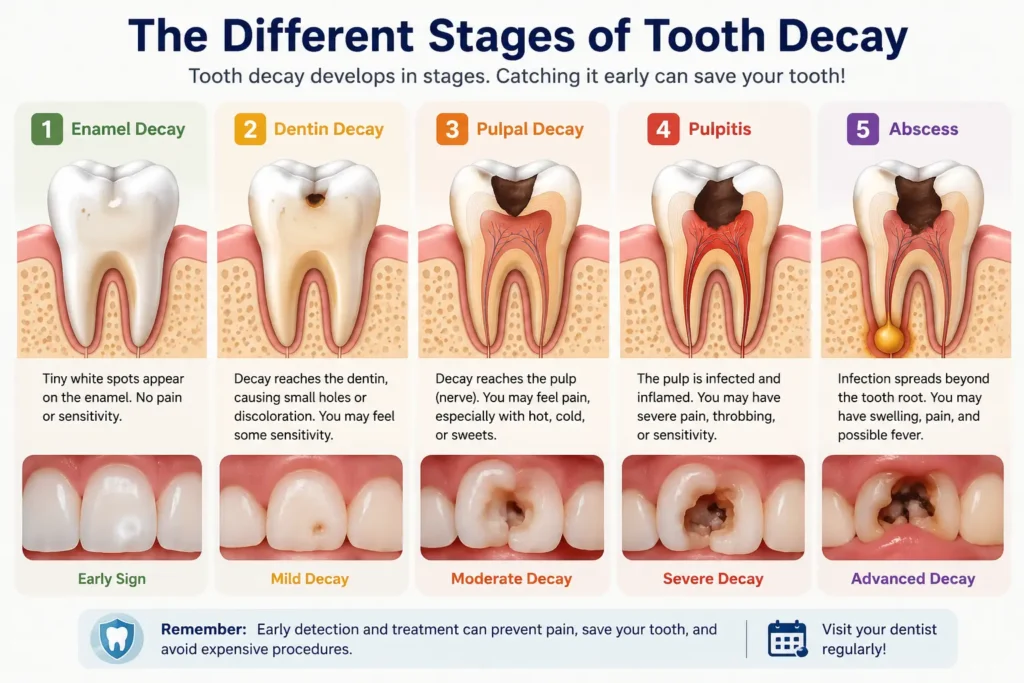
A cavity does not appear in a single day. It is developed over some stages.
Stage 1: Mineral Loss
Acids begin to strip minerals out of the enamel.
You might only see an unctuous white spot.
There is generally no need for.
Stage 2: Enamel Damage
The outer layer starts breaking down.
Small brown areas can appear.
Tiny pits can form.
The sensitivity may start when you eat sweets.
Stage 3: Dentin Decay
When bacteria get into the dentin, it causes the cavity to get bigger.
The tooth can be transformed into:
- Darker
- Softer
- More delicate
Drinking cold beverages can suddenly cause discomfort.
Stage 4: Deep Decay
The cavity is easy to observe.
You may notice:
- A visible hole
- Black discoloration
- Food getting stuck
- Persistent pain
At this point, an easy filling might not be sufficient anymore.
Where Cavities Usually Form
Each tooth’s component has an equal risk.
Dentists often discover cavities in these locations.
Between Teeth
Food particles are easily trapped there.
Since toothbrush bristles aren’t able to always access these places, flossing is crucial.
Back Molars
The grooves in the chewing teeth absorb food and bacteria.
These areas are responsible for a lot of cavities that affect children as well as adults.
Near the Gumline
Plaque is often formed at the point where the tooth is in contact with the gums.
Lack of brushing could let decay develop around this point.
Around Old Fillings
Older dental work may develop tiny gaps.
Bacteria can get into these spaces, causing decay.
What Causes Tooth Decay?
A cavity is formed when several elements work together.
The most frequently cited causes include:
- Poor brushing habits
- Doing the wrong thing with floss
- Regular sugary snacks
- Soft drinks
- Sticky candy
- Dry mouth
- Smoking
- Drinks with acidic ingredients
- Poor oral hygiene
- Insufficient fluoride
- Infrequent dental checkups
A sugary snack will not cause an immediate cavity. The problem is triggered by repeated acid attacks that gradually weaken enamel.
Who Has a Higher Risk?
While everyone can develop cavities, certain people are at more risk.
This includes:
- Children
- Teenagers
- Older adults
- Dry mouth sufferers
- Braces are worn by people who wear braces.
- Regular soda drinkers
- People who eat snacks throughout the day
- Patients who have poor oral hygiene
Certain medications may also decrease saliva, which makes the possibility of developing cavities higher.
Why Finding a Cavity Early Matters
Early treatment has many beneficial advantages.
| Early Detection | Waiting Too Long |
| Smaller fillings | Larger fillings |
| Cost of lower treatment | Higher dental bills |
| Less discomfort | More pain |
| Better dental health | More chance of losing teeth |
| More efficient appointments | More complicated procedures |
I’ve seen a lot of people put off treatments because they’re not yet hurt. After a few months, the tiny spot became a painful and insidious cavity that required a lot more work. Finding problems early helps save time, money, and anxiety.
Step-by-Step Guide to Checking Your Teeth at Home
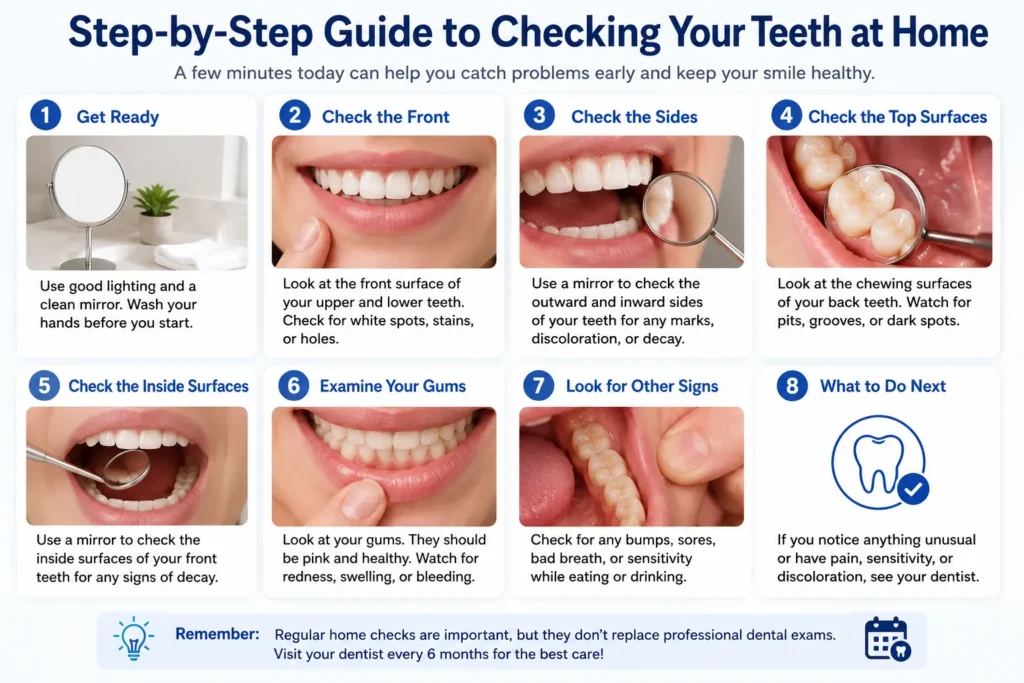
A home visit won’t substitute for the need for a dental examination, but it can assist you in identifying changes before they occur.
Step 1: Find Good Lighting
Sit before an illuminated mirror. Natural light is the best option, but bathroom lighting or a small flashlight may assist.
The right lighting can make it easier to identify the white flecks, spots and small holes.
Step 2: Dry Your Teeth
Make use of a clean towel or gauze to clean the teeth you’re looking at.
Dry teeth can make the early white spots easier to spot because water can cover the spots.
Step 3: Look for Color Changes
Make sure to examine each tooth with care.
Be on the lookout for:
- White chalky patches
- Yellow areas
- Brown staining
- Black spots
- Dark grooves
Be aware that not every stain is a tooth cavity. Tea, coffee, tobacco, and a few foods can also cause discoloration of teeth.
Step 4: Check the Surface
Your tongue is gently brushed over the tooth.
Healthy enamel feels silky smooth.
If a particular area is rough, sharp, or uneven, then it might require attention from a professional.
Step 5: Pay Attention While Eating
The mouth is often a clue prior to the appearance of a cavity.
Note if you feel:
- The pain when chewing
- The sensitivity to cold beverages
- Hot food can cause discomfort.
- Sharp pain after eating sweets
These signs don’t necessarily mean there’s a cavity; however, they shouldn’t be overlooked.
Step 6: Schedule Regular Dental Visits
Even if all appears to be normal, dentists might discover decay that’s not evident through the lens.
Small dental cavities typically occur only in dental X-rays.
Benefits of Finding Tooth Decay Early
The early treatment of a cavity has numerous advantages.
Saves Money
Small fillings are much cheaper than crowns, root canals, and tooth replacement.
Prevents Pain
Most cavities discovered early cause little or no discomfort.
Affecting them before they reach the nerve is a way to prevent severe toothaches.
Protects Your Natural Tooth
The less decay a dentist has to take out, the healthier the tooth structure is left.
Making sure your natural teeth are strong is the most effective way to achieve your goal.
Reduces Treatment Time
Filling a simple form usually will take less than half an hour.
Advanced decay could require several appointments over a period of time.
Challenges of Spotting Cavities Yourself
While examining the health of your teeth at home can be beneficial, it is not without its limitations.
A few cavities:
- Hide between teeth
- Former fillings form a new one.
- Begin at the gumline
- Develop painlessly and without discomfort
- Can’t be seen without X-rays
That’s why self-checks should support–not replace–professional dental care.
Common Mistakes People Make
Many people ignore the warning signs of tooth decay.
These are some of the most frequent errors that are made.
Assuming It Doesn’t Hurt
Pain isn’t the only symptom.
A lot of cavities can grow over time before they cause discomfort.
Ignoring White Spots
The majority of people are focused on black holes.
In fact, white spots could be the first evidence of enamel damage.
Believing Every Dark Spot Is a Cavity
Some dark marks are harmless stains.
Only a dentist can determine whether there is decay.
Waiting Too Long
A small, tiny hole is rarely healed by itself when a hole develops.
The delay in time allows the damage to spread further.
Brushing Too Hard
Brushing aggressively doesn’t eliminate cavities.
In reality, it could cause enamel to wear away and irritation to your gums.
Common Misconceptions
Let’s debunk some of the misconceptions.
| Myth | Reality |
| Black is the color of the Cavities. | Early cavities are usually white. |
| If it’s not painful, it’s good for you. | Most cavities aren’t painful at the beginning. |
| Sugar alone can cause cavities. | Acid, bacteria, and poor oral hygiene can all contribute to. |
| Adults don’t get cavities often. | Ages vary for adults. can get tooth decay. |
| Mouthwash is a great remedy for cavities. | Mouthwash is a great way to reduce the presence of bacteria, it cannot fix a chip in the tooth. |
Expert Tips for Healthy Teeth
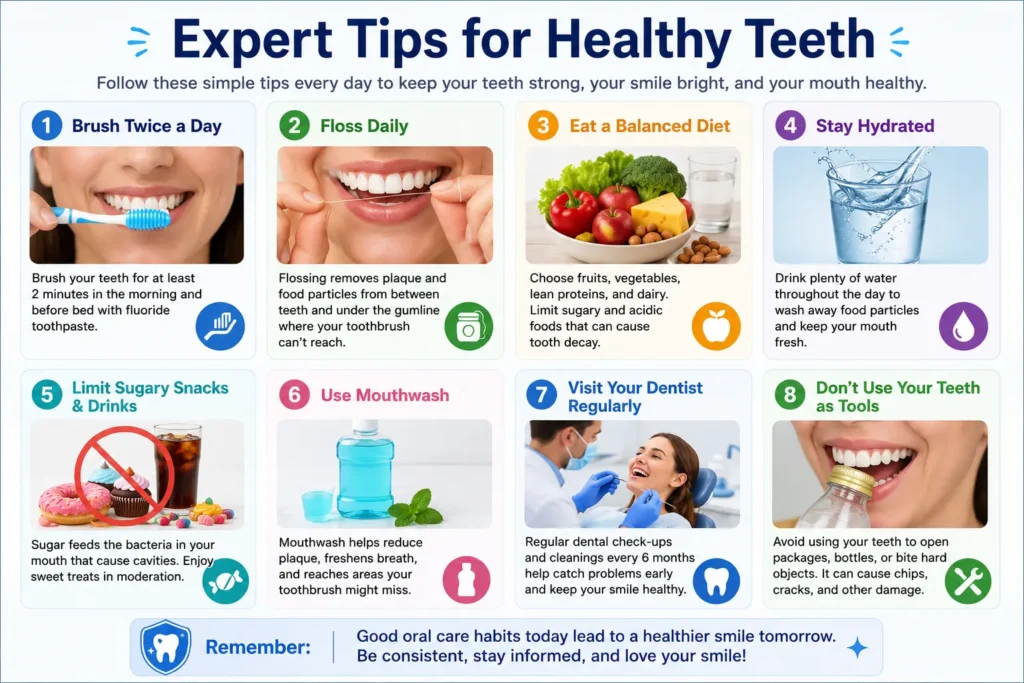
After observing for years the habits of dental hygiene, one thing is clear: consistency is more important than perfection.
You don’t require expensive items or complex routines. Simple daily habits can make the biggest impact.
Here are some helpful suggestions:
- Every day, brush twice with fluoride toothpaste. Brush twice daily.
- Make sure you floss at least once per day.
- Drink plenty of water, particularly at the end of meals.
- Beware of sticky and sugary drinks. snacks.
- Drink sugar-free gum immediately after you eat if it’s impossible to brush.
- Change your brush every 3 or four months.
- Visit your dentist at least every 6 months or when recommended.
- Do not ignore any tooth sensitivity, regardless of whether it appears and goes away.
A routine of just a few minutes each day will do more for your dental health than having to brush more vigorously every once in a while.
Frequently Asked Questions
Can the cavity be white rather than black?
Yes. Early cavities usually appear as white, chalky spots due to the fact that minerals are leaving the enamel. They typically darken as decay continues.
Does every brown spot indicate that there is a cavity?
No. Brown spots can be caused by smoking, certain foods, or even natural staining. A dentist can identify if the spot is caused by decay.
How can I prevent a cavity from becoming worse?
If decay is detected before the formation of a hole, treatment with fluoride and good oral hygiene could help to strengthen the enamel. When a cavity forms an irreparable hole, the dentist will be required.
Do you think that cavities are always painful?
No. A lot of cavities don’t cause discomfort until they get to the higher levels of the tooth.
Do I have the ability to treat a cavity at home?
No. DIY solutions aren’t able to fix damaged teeth. A good brushing routine and fluoride treatment can aid in preventing further damage; however, existing cavities require the attention of a dentist.
How fast does the cavity develop?
It differs from person to person. Dental hygiene, diet, as well as saliva and general dental health, affect the speed at which tooth decay develops.
When should I visit my dentist?
Schedule an appointment if you are concerned about:
- A new dark spot
- A visible hole
- Sensitivity to change
- It is painful when chewing
- Food gets trapped in one of the teeth
- A swelling around the gums
Treatment early is generally less expensive and simpler to pay for.
Quick Summary
Here’s the key to remember:
- Cavities don’t always look like black holes.
- Dental decay that is early usually begins with a white spot of chalky stains.
- Stains of brown, rough patches, and small pits could be a sign of the presence of a problem.
- The pain typically shows up later, and not at first.
- Regular flossing, brushing, as well as fluoride treatment on a regular basis, and dental visits can help to prevent the majority of dental cavities.
- Dental professionals can spot hidden decay that is difficult to discern at home.
Final Thoughts
Knowing what a tooth’s appearance is like can give you a better chance of securing your smile from serious damage before it is caused. The first signs are usually small, like a white spot, a small brown stain, or an unintentional bump that doesn’t appear to be anything major. But these small changes could be the first indication of enamel deteriorating.
Regularly checking your teeth, keeping your mouth clean, and seeing your dentist regularly for routine examinations are the best ways to spot problems before they become serious. If you notice something unusual, SmileCare
don’t wait for discomfort to develop. If you act sooner, you can save your tooth, cut down on the cost of treatment, and also aid in avoiding more costly dental procedures in the future.
A healthy smile doesn’t mean getting perfect teeth. It’s about noticing minor changes and taking care of them before they turn into major issues.